
Airports & aviation
Landing at Santo Domingo Airport (SDQ): Which Airport, Which Drive
Almost certainly Las Américas (SDQ), which sits east of the capital on the coast and handles nearly all international traffic.
- Published
- the Transekur team
- 5 min read
- Airports & aviation
Almost certainly Las Américas (SDQ), which sits east of the capital on the coast and handles nearly all international traffic.
Which Santo Domingo airport (SDQ) are you actually landing at?
There is a second airport. La Isabela (JBQ), north of the city, is a small field used mainly for domestic and regional flights. It is a genuinely different place, on the opposite side of a large capital city, and the drive between the two is nothing like a terminal transfer.
Travellers book flights to "Santo Domingo" without checking which airport the ticket actually names, and then book a transfer against the wrong one. Check your booking reference now, before anything else on this page matters. If it says SDQ, everything below applies.
If you are still choosing where to fly into, our guide to choosing the right Dominican airport compares SDQ, Punta Cana and the regional fields on drive time rather than airfare alone.
Arrivals and the walk out
Las Américas is a conventional enclosed terminal — unlike Punta Cana, you arrive through a jet bridge into an air-conditioned building.
You will need the Dominican E-Ticket completed before arrival. It produces a QR code, and you will be asked for the code rather than a paper form. Fill it in before you fly; doing it on airport wifi at the front of the queue is how families lose twenty minutes.
Queues at SDQ are generally shorter than at Punta Cana, because the arrival pattern is steadier and less dominated by simultaneous wide-body landings.
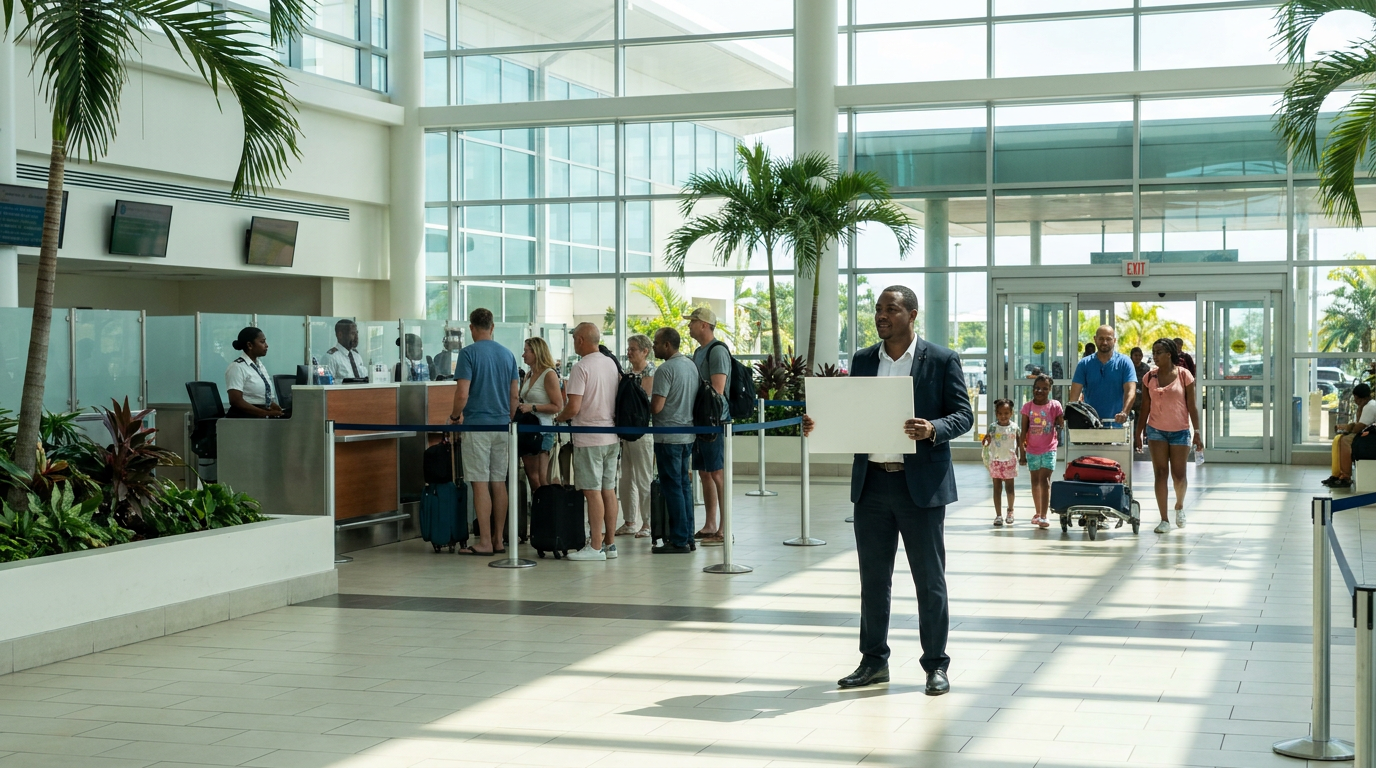
Beyond customs, authorised drivers wait in the designated meeting area with a name board. Anyone approaching you before you have cleared customs is not an authorised operator.
Into the colonial city
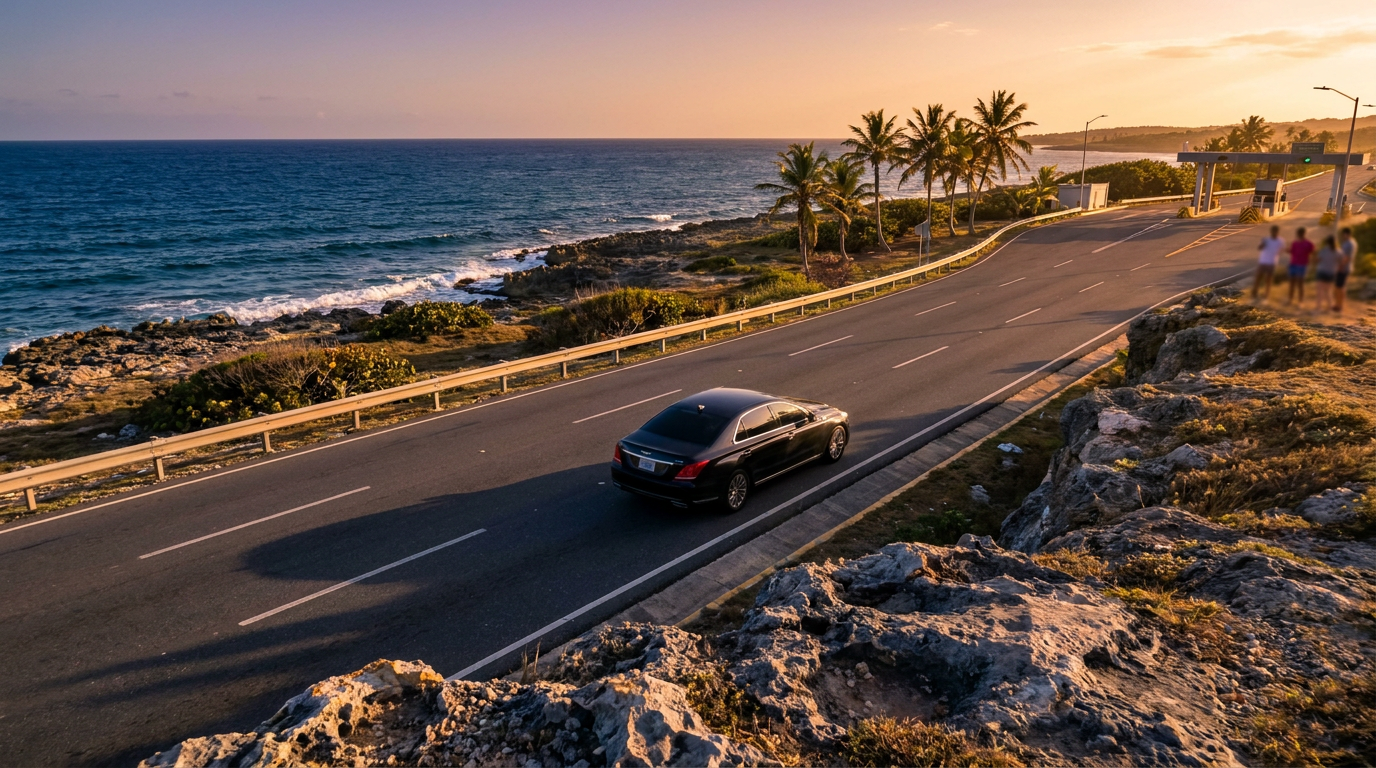
About 36 minutes, roughly 33 km, west along the Autopista Las Américas with the sea on your left for most of the way.
It is one of the more pleasant airport drives in the Caribbean — a genuine coastal road rather than a ring route through industrial estates.
The Colonial City is the UNESCO-listed historic core and where most first-time visitors stay. Piantini and Bella Vista are the modern business districts, and the Malecón is the seafront boulevard connecting much of it. They are different neighbourhoods with different characters and different traffic at different hours, so the hotel address matters more than the city name.
The long runs east: Punta Cana, Bayahíbe and Samaná
If you booked SDQ intending to reach Punta Cana, know before you land that this is a genuine two-hour drive, not a short hop.
| Destination | Drive time | Distance | |---|---|---| | Colonial City / Distrito Nacional | about 36 min | 33 km | | Juan Dolio | about 33 min | 36 km | | Bayahíbe | about 1 hr 20 min | 110 km | | Casa de Campo / La Romana | about 1 hr 20 min | 104 km | | Bávaro | about 2 hr | 173 km | | Punta Cana / Cap Cana | about 2 hr | 174 km | | Samaná | about 2 hr 15 min | 146 km | | Las Terrenas | about 2 hr 30 min | 144 km | | Uvero Alto | about 2 hr 35 min | 168 km |
Plenty of travellers book SDQ on price or schedule and only discover the distance afterwards. It is often still the right call — the fare difference can be substantial and the roads are good — but it is a decision worth making deliberately rather than by accident.
Juan Dolio at about 33 minutes is the quiet outlier here: a beach base closer to the airport than the capital's own colonial centre.
For the Bayahíbe and Casa de Campo end of that table, we cover the same run from the other direction in Punta Cana Airport to La Romana and Bayahíbe.
Night arrivals
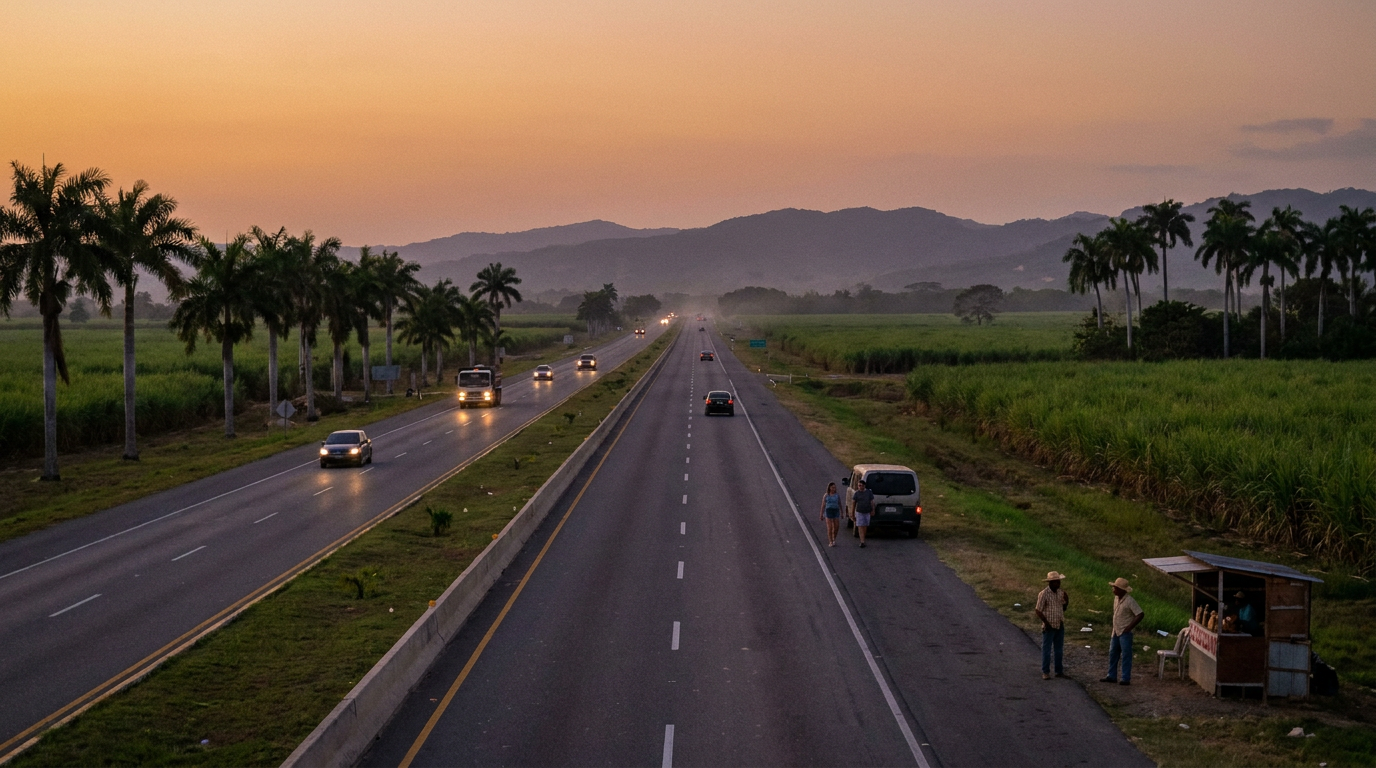
The Autopista Las Américas is lit, dual carriageway and straightforward at any hour, so a late arrival into the capital itself is not a problem.
The eastern runs are a different matter. Once you leave the main highways, rural stretches are unlit, shared with motorbikes and occasionally livestock, and poorly signposted. A two-hour drive to Punta Cana at one in the morning is not a drive to improvise.
A pre-booked transfer is tied to your flight number, so a delay moves the pickup rather than losing it. That is the whole argument for arranging it in advance: the later and more delayed the arrival, the more it matters.
What the price covers, and who pays the tolls
Both the Autopista Las Américas and the Autopista del Coral are toll roads, and tolls are included in a private transfer price. There is nothing to pay at the booths and no need to carry pesos for them.
The price is per vehicle, not per person. The shared alternative is priced per seat and collects at multiple hotels before yours — which on a two-hour eastern run can add a great deal of time.
Three things move a quote: vehicle size, driven by passengers plus luggage; time of day, since very early and very late arrivals cost more to staff; and whether it is a round trip, which is better value than two one-way bookings and removes the problem of arranging a departure from somewhere with no reliable ride-hail coverage.
Vehicles, child seats and groups
Vehicle choice is driven by luggage as much as by headcount. Four passengers with four large cases and a pushchair do not fit the same car as four passengers with cabin bags.
Child seats are requested at booking and fitted before the vehicle reaches the airport — not something to sort out at the curb.
For groups arriving on separate flights into the same hotel, say so when booking. Arrivals can be coordinated into fewer vehicles or staged pickups rather than duplicated, which matters most on the long eastern routes where a wasted run is two hours each way.
Every booking includes flight monitoring, a driver waiting inside the terminal with a name board, and a direct route with no other stops.